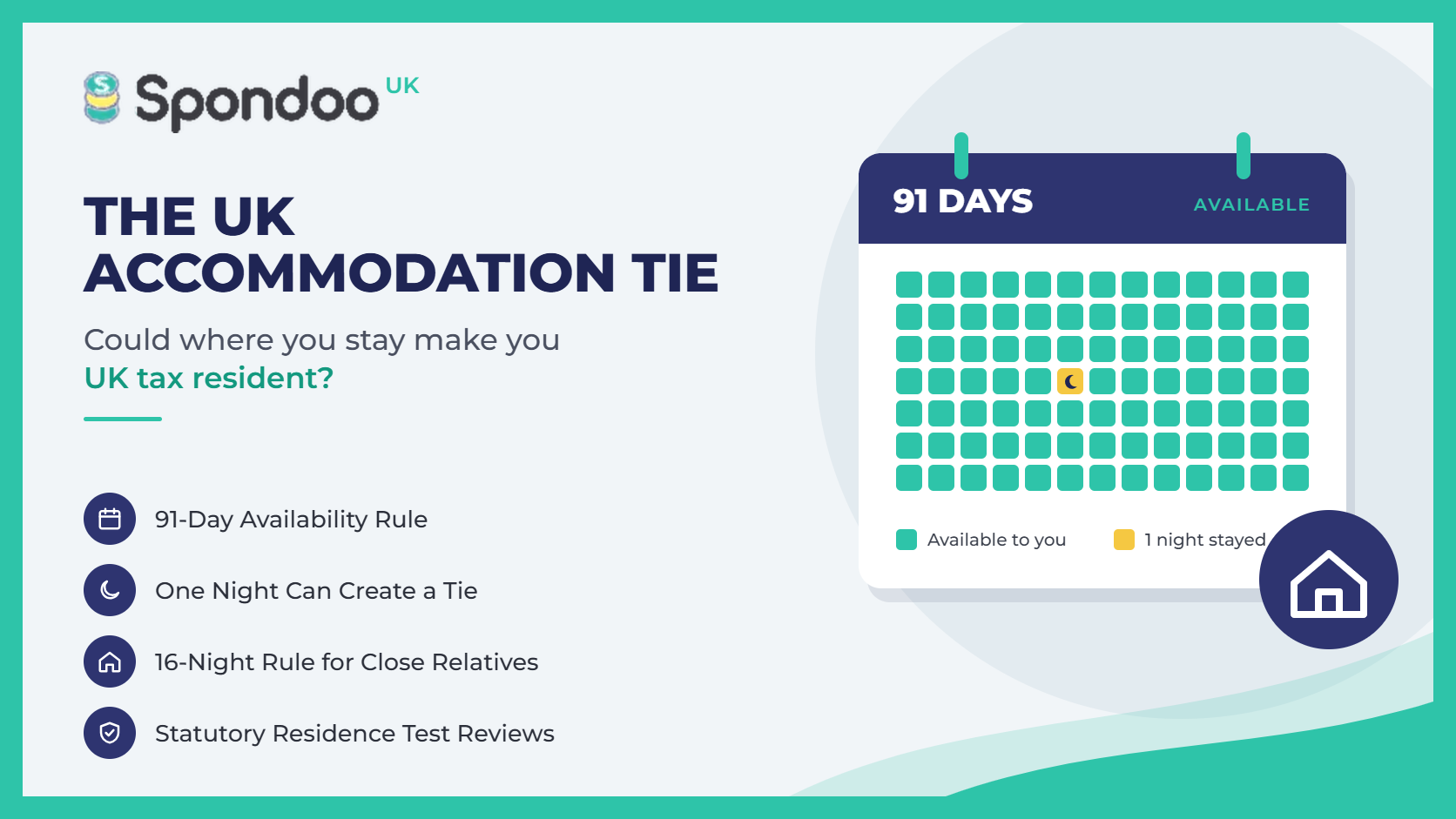
When determining whether someone is UK tax resident under the Statutory Residence Test, the number of days spent in the UK is only part of the calculation.
Depending on your circumstances, you must also consider your connections—or "ties"—to the UK. One of these is the accommodation tie.
This tie is easily misunderstood. Merely having somewhere to stay in the UK does not automatically create an accommodation tie. Equally, temporary accommodation such as an Airbnb can create one if it remains available for long enough.
You normally have an accommodation tie for a tax year where:
The threshold is 91 days—not 90 days.
The accommodation does not need to be your permanent home. It could include:
Ownership is not the deciding factor. The important question is whether that particular accommodation was genuinely available for your use for at least 91 continuous days.
For most types of accommodation, you only need to spend one night there during the tax year.
For example, suppose you own a UK property that is available to you throughout the tax year. Even if you normally live overseas, spending a single night in that property would generally create an accommodation tie.
This does not automatically make you UK resident. It gives you one UK tie, which must then be considered alongside:
The more UK ties you have, the fewer days you may be able to spend in the UK without becoming UK resident.
A more generous occupation rule applies where the accommodation is the home of a close relative.
For this purpose, a close relative includes:
Where you stay in the home of a close relative, the accommodation tie generally only arises if:
It is 16 nights—not more than 16 nights.
However, staying with your parents for 16 nights does not automatically create an accommodation tie. Their home must also have been genuinely available to you for the required 91-day period.
A casual invitation to visit for a few days is not necessarily enough. By contrast, a genuine standing arrangement under which your parents are prepared to accommodate you whenever you are in the UK, including for an extended period, could mean their home is continuously available to you.
Daniel lives overseas but has an ongoing arrangement with his parents that he can stay at their UK home whenever he visits. They would be prepared to accommodate him for more than 91 days if required.
During the tax year, Daniel makes several visits and spends a total of 18 nights at his parents' home.
Daniel is likely to have an accommodation tie because:
If Daniel had spent only 15 nights there, the special occupation condition would not be satisfied.
An Airbnb can count as available accommodation. The result depends on how long that particular Airbnb is available to you.
Amelia books one Airbnb in London for 80 continuous days and stays there throughout the booking.
She would not ordinarily have an accommodation tie from that Airbnb because it was not available to her for at least 91 continuous days.
It does not matter that she actually occupied it for all 80 days. The 91-day availability requirement has not been satisfied.
Ben books one Airbnb for 100 continuous days. He stays there for part of the booking but travels outside the UK during the remainder.
Ben is likely to have an accommodation tie because:
He does not need to sleep there for 91 nights. It is the period of availability, rather than the number of nights spent there, that must reach 91 days.
Different properties are considered separately.
Charlotte spends 100 continuous days in the UK. She books:
Although Charlotte has accommodation somewhere in the UK for 100 days, neither individual Airbnb was available to her for at least 91 continuous days.
She would therefore not ordinarily have an accommodation tie based solely on those two bookings.
The two 50-day periods are not simply added together. Each particular place of accommodation must be considered separately.
Charlotte must still consider whether she has any other accommodation available to her, such as a property she owns, a room kept available by a friend or relative, or another UK home.
There is a limited rule for short interruptions in the availability of the same accommodation.
Where there is a gap of fewer than 16 days between periods in which the same accommodation is available, the gap is ignored when determining whether the accommodation was continuously available.
For example:
The short gap is ignored. The accommodation may therefore be treated as continuously available across the entire period, potentially creating an accommodation tie.
If the gap is 16 days or longer, the periods are normally treated separately.
This rule does not generally allow you to combine bookings at completely different properties. A 50-day booking at one Airbnb and a 50-day booking at another remain separate, even if the bookings are back-to-back.
The same principles can potentially apply to hotels and serviced apartments. A single short hotel visit will not normally satisfy the 91-day condition.
However, if the same hotel room or other identifiable accommodation is reserved and remains at your disposal for at least 91 continuous days, it could create an accommodation tie once you have stayed there for at least one night.
Regularly staying at different hotels does not ordinarily allow all the separate stays to be combined.
The accommodation tie is based on the availability of a particular place to live, not simply whether you have found somewhere to sleep while visiting the UK.
The following distinctions are therefore important:
| Arrangement | Likely accommodation-tie position |
|---|---|
| One Airbnb available for 80 days | No tie from that Airbnb |
| One Airbnb available for 100 days and used for one night | Likely accommodation tie |
| Two different Airbnbs available for 50 days each | Normally no accommodation tie from either |
| UK property owned and available all year, used for one night | Likely accommodation tie |
| Parents' home available for at least 91 days, used for 16 nights | Likely accommodation tie |
| Parents' home available for at least 91 days, used for 15 nights | Normally no tie from that accommodation |
| One-off invitation to stay with a friend for a few nights | Normally no accommodation tie |
| Same accommodation with interruptions shorter than 16 days | Periods may be treated as continuous |
Having an accommodation tie does not, by itself, make you UK tax resident.
It is one component of the sufficient ties test. Its effect depends on:
The rules concerning a "home" under the automatic UK residence test are also different from the accommodation-tie rules. A person's complete residence position should therefore be reviewed under the Statutory Residence Test as a whole.
If your UK residence status is sensitive, keep clear records of:
A seemingly minor decision—such as extending an Airbnb booking from 80 days to 100 days—could create an additional UK tie and potentially change your UK residence position.
The safest approach is to calculate your expected UK days and ties before making long-term accommodation arrangements.
The Statutory Residence Test can become complicated very quickly—particularly where you travel frequently, use several properties or stay with family while visiting the UK.
Spondoo Accountants can review your travel dates, accommodation arrangements and other UK ties to help determine your likely UK tax residence position. We can also advise you before you travel, allowing you to understand how additional days or accommodation arrangements could affect your status.
This article provides general information only and does not constitute tax advice. UK residence depends on the individual's complete circumstances and the Statutory Residence Test should be applied in full.