Call for Assistance: 02033 259 341
Spondoo Accounting
Call for Assistance: 02033 259 341
Spondoo Accounting

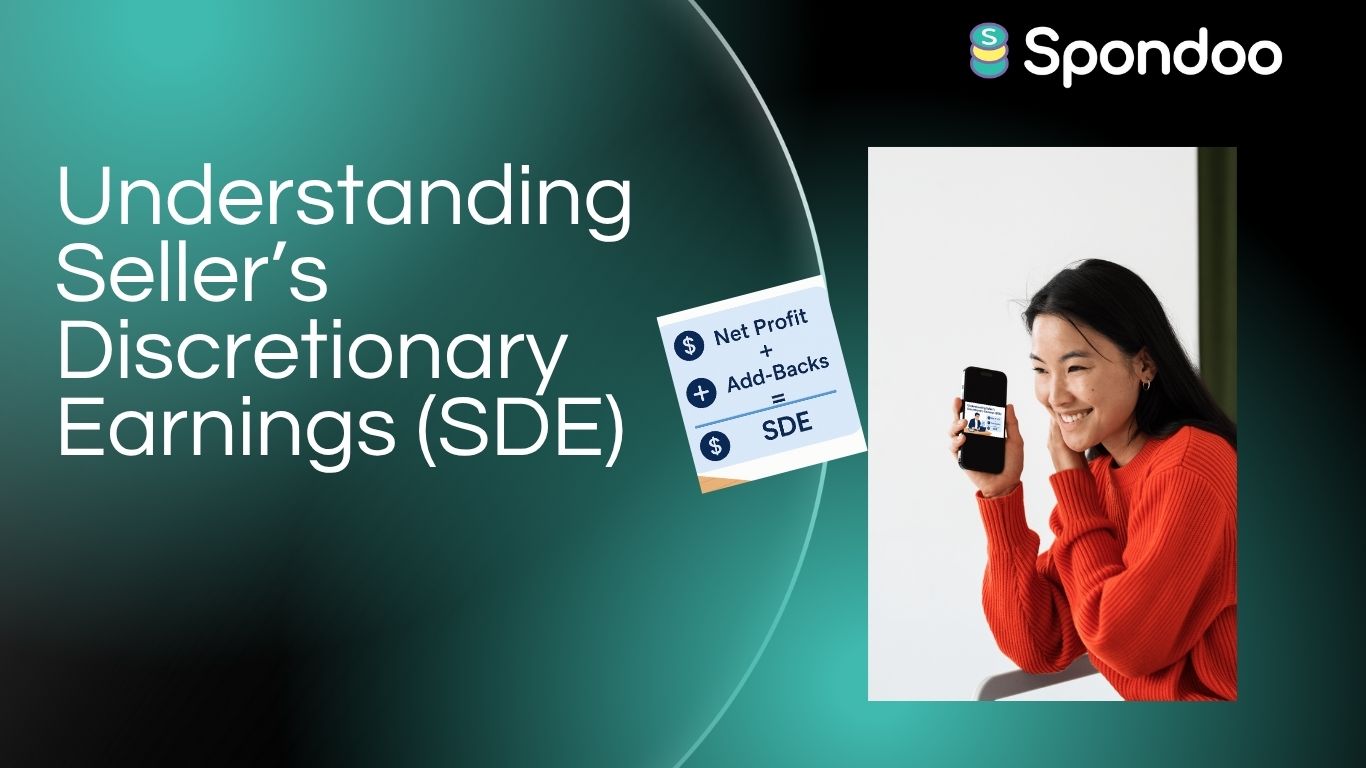
Understanding Seller’s Discretionary Earnings (SDE)

November 20, 2025

Understanding Seller’s Discretionary Earnings (SDE)?

When valuing a small business, one of the most important financial metrics is Seller’s Discretionary Earnings (SDE). It provides a clear picture of the total financial benefit that a single owner-operator can expect from the business.

In simpler terms, SDE tells you how much money the owner actually makes, after adjusting for personal, one-time, or non-essential business expenses.

What is SDE? 

SDE starts with the business’s net profit and then adds back certain expenses that are considered discretionary or non-essential to daily operations.

These add-backs are adjustments that remove distortions caused by personal spending or rare expenses, helping buyers see what the business really earns.

Common Add-Backs in an SDE Calculation

Here’s what’s typically added back when calculating SDE:

  • Owner’s Salary and Benefits

If the business pays the owner a salary, that amount is added back, since a new owner might pay themselves differently or hire someone at a different rate.

  • Personal or Lifestyle Expenses

Many small business owners run certain personal costs through the business (like vehicle use, travel, or phones). These are added back because they’re not essential to operations.

  • Non-Recurring or One-Time Expenses

Expenses that happen only once, such as moving costs, legal settlements, or special consulting fees, are added back since they won’t affect future earnings.

  • Interest, Depreciation, and Amortization

These are accounting or financing costs, not operational ones. Interest depends on how a buyer finances the business, and depreciation is non-cash, so both are added back.

  • Family or Related-Party Wages

If relatives are paid through the business but don’t actually work in it, those wages are added back to show the company’s genuine performance.

The goal is to show the true earning power of the company for a potential buyer, without the distortions caused by personal or non-operational spending.

Why it Matters in Business Valuation

SDE is most relevant for small to medium-sized businesses, especially those run by a single owner.
In such businesses, it’s common for personal and operational expenses to blend together — making the net profit alone a poor reflection of true value.

How SDE Helps Buyers and Sellers

  • For buyers: It gives a realistic picture of what they could earn as the new owner.

  • For sellers: It helps justify the asking price with transparent and standardized figures.

  • For brokers: It allows easier comparison between businesses using an industry multiple (often 2–3x SDE) to estimate fair market value.

A well-calculated SDE reassures potential buyers and helps sellers justify their asking price with transparent, standardised figures.

Spondoo Accountants: Helping You Get SDE Right

At Spondoo Accountants, we help business owners produce accurate, defensible SDE calculations that truly reflect their company’s performance.

Whether you’re preparing to sell your business, looking to attract investors, or simply wanting to understand your company’s value, our team ensures your financials are clear, credible, and ready for valuation.

We identify legitimate add-backs, remove personal noise, and create reports that stand up to scrutiny.

FAQs About Seller’s Discretionary Earnings (SDE)

1. What exactly does SDE mean?

SDE (Seller’s Discretionary Earnings) shows the total income a single owner can take home from a business after adding back personal, non-recurring, or discretionary expenses.

2. How is SDE different from net profit?

Net profit is what’s left after all expenses, but it includes the owner’s salary and personal costs.
SDE adjusts for these, showing what the business really earns for one full-time owner-operator.

3. What are add-backs, and why are they important?

Add-backs are adjustments that remove one-time or personal expenses.
They’re crucial because they reveal the company’s true earning power and ensure the valuation is fair and comparable across businesses.

4. How do buyers use SDE in valuation?

Buyers often apply an industry multiple to SDE (usually 2–3x) to estimate the business’s market value.
For instance, if a business has £200,000 in SDE and the industry multiple is 2.5, it might be worth around £500,000.

5. What’s the difference between SDE and EBITDA?

Both measure profitability, but EBITDA (Earnings Before Interest, Taxes, Depreciation, and Amortization) excludes the owner’s salary and benefits.
EBITDA is used for larger, investor-led businesses, while SDE suits owner-operated small businesses.

In short:

  • SDE = Total earnings for one owner

  • EBITDA = Profit from business operations, regardless of ownership

6. Can I calculate SDE on my own?

Yes, but it’s best to work with a qualified accountant to ensure your add-backs are reasonable and defensible, especially if you plan to sell or attract investors.

Final Thoughts

Seller’s Discretionary Earnings (SDE) is one of the most powerful metrics in small business valuation.
It gives an honest view of a company’s true profitability, beyond the tax figures and accounting adjustments.

If you’re thinking about selling, buying, or simply understanding your business’s worth, getting your SDE right is crucial.
And with experienced advisors like Spondoo Accountants by your side, you can ensure your numbers speak the truth.


more tips

Can You Claim Food as a Business Expense?

The golden rule when claiming business expenses is that the cost must be “wholly and exclusively” for business purposes. So, where do you stand when it comes to food and drink? After all, everyone needs these things to survive. When does it become an allowable expense? Read on to find out when your business can claim food and drink as an expense.
READ MORE

Self-Employed National Insurance Class 2 and Class 4 Rates

If you are sixteen and over, self-employed (sole trader or in a partnership) and making a profit befitting the ‘small profits threshold’, you are liable to pay national insurance.
READ MORE

Key UK Personal Tax Year Dates & Deadlines 2021/2022

Are deadlines creeping up on you? Spondoo is here to ensure you keep on top of things and take control again. These are the important dates you should take note of.
READ MORE

How To Set Up A Limited Company 

A Step-by-Step Guide  This is an easy-to-understand, step-by-step guide, to opening a successful limited company. But before we dive in, let’s check the legality surrounding it. 
READ MORE

Accountants in Haslemere, Surrey

We are qualified accountants providing personal and professional services for start-ups, established companies and individuals in and around the Haslemere area in Surrey. With the rise in technology, we have embraced the digitisation of accounting using efficient digital accounting tools to offer reliable services to our customers. Our goal remains to get our clients the best accounting and taxation services at the most affordable rates.
READ MORE

Onsite Canteen and Lunch Vouchers - Are They Taxable?

The provision of food and drink to an employee by their employer is a lovely thing to do. Eventually, it promotes teamwork, loyalty, a sense of belonging and even improves productivity. Taking it at face value makes it look like a simple act of kindness. However, unless it is done correctly, it can cause tax and national insurance compliance issues for the employer.
READ MORE
1 2 3 49
LEARN MORE
What the service includes, and how much it costs?
ICAEW SPONDOOACSP LOGO SPONDOOIFA
XERO GOLD PARTNER
Information provided on this site is for general guidance only and may change in line with UK law and regulations. It should not be relied upon as financial advice or as the sole basis for making decisions. Accounting SQL Limited (trading as Spondoo) is authorised and regulated by the Institute of Financial Accountants (IFA). Spondoo Audit Limited is authorised and regulated by the Institute of Chartered Accountants in England and Wales (ICAEW) to provide statutory audit services.
© Copyright 2025 - Spondoo - All Rights Reserved
How, can we help?
linkedin facebook pinterest youtube rss twitter instagram facebook-blank rss-blank linkedin-blank pinterest youtube twitter instagram