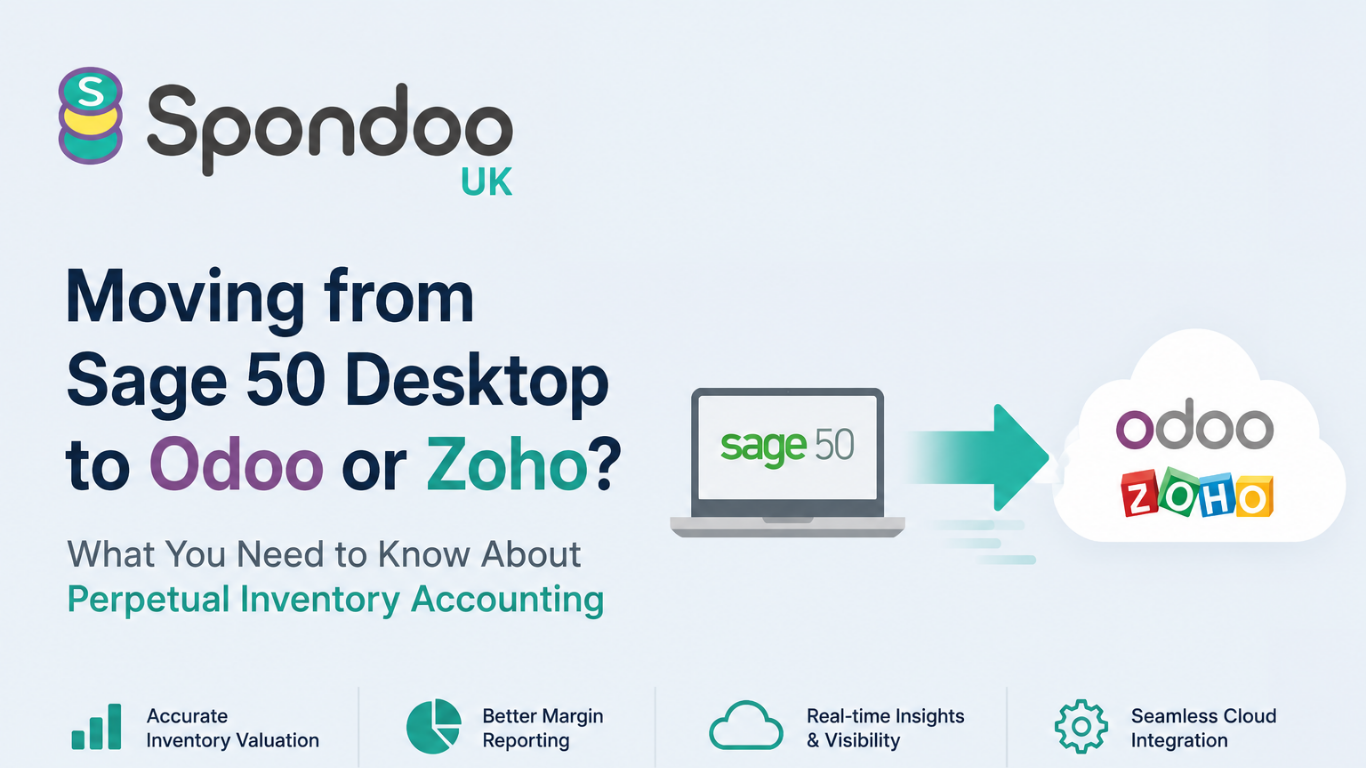
When businesses move from Sage 50 Desktop to cloud-based systems such as Odoo or Zoho, they often focus on convenience: better access, cloud hosting, integrations, automation and improved reporting.
However, one of the biggest accounting differences is often overlooked.
That difference is perpetual inventory accounting.
For businesses that carry stock, this can be one of the most important reasons to move from a traditional desktop accounting system to a more modern cloud-based platform.
Perpetual inventory accounting is a method where stock movements and accounting entries are closely linked.
When inventory comes into the business, the accounting value of stock is updated. When inventory leaves the business, the accounting value of stock is reduced and cost of sales is recognised.
In simple terms, the accounts move as the stock moves.
For example, when goods are sold, a perpetual inventory system can record both sides of the transaction.
This means the system records not only the sale to the customer, but also the cost of the stock that has been sold.
The result is a more immediate and accurate view of gross profit.
In Sage 50 Desktop, sales invoices and purchase invoices are generally accounting transactions. Stock records can also be updated, but the link between operational stock movement and nominal ledger accounting is not always as integrated as it is in systems designed around perpetual inventory.
In practice, many Sage 50 businesses rely on periodic stock adjustments.
That means cost of sales and closing stock may be adjusted monthly, quarterly or annually, often by journal.
For example, a business may run a stock valuation report at month-end or year-end, compare this to the balance sheet, and post journals to adjust opening stock, closing stock or cost of sales.
This can work, but it has limitations.
It means the profit and loss account during the month may not show a reliable gross margin. The balance sheet stock figure may not reflect the latest stock position. Management may only get an accurate view once manual adjustments have been made.
For businesses with simple stock, this may be acceptable. For businesses with fast-moving stock, imported goods, multiple sales channels or tight margins, it can be a problem.
Odoo and Zoho can support more structured inventory accounting.
Odoo, for example, allows businesses to define both the costing method and whether inventory valuation is manual or automated. Depending on configuration, the system can create accounting entries when stock enters or leaves the warehouse.
Zoho also supports recognised inventory valuation methods such as FIFO and weighted average costing.
This gives businesses more control over how stock value is calculated and how it flows into the accounts.
The key difference is that inventory accounting becomes part of the transaction workflow, rather than something corrected later by manual journal.
Another important difference is the ability to define the inventory valuation method.
In Sage 50 Desktop, stock valuation is commonly driven by Sage’s own average cost calculation. Sage provides guidance on how average cost price is calculated, but businesses have relatively limited flexibility over the underlying valuation method.
By contrast, Odoo and Zoho can offer more configurable valuation options, depending on the system and edition being used.
This matters because the valuation method affects the accounts.
It can change:
For example, FIFO assumes the oldest stock costs are consumed first. Weighted average cost smooths the cost of stock across purchases. Standard cost uses a defined expected cost and deals separately with variances.
These are not just software preferences. They are accounting policy decisions.
The main benefit of perpetual inventory accounting is better gross margin reporting.
In a periodic system, sales may be recorded immediately, but the related cost of sales may only be adjusted later. This means profit can look artificially high until the stock adjustment is posted.
In a perpetual system, the cost of the item sold is recognised much closer to the time of sale.
That means management can see a more realistic picture of:
This is especially important where prices fluctuate.
If a business buys the same product at different costs throughout the year, the valuation method can materially affect margin reporting. A system that tracks this properly can provide much better insight than one that relies on broad periodic adjustments.
Imagine a business buys 100 units of a product for £10 each.
It later buys another 100 units for £14 each.
It then sells 50 units for £25 each.
Under a basic sales accounting process, the system may record the sale as:
But this does not show the cost of the goods sold.
A perpetual inventory system also records the inventory side.
Depending on the costing method, it may recognise cost of sales based on FIFO, average cost or another selected method.
For example, under FIFO, the first 50 units sold may be costed at £10 each, giving cost of sales of £500.
This gives management far better information than waiting until month-end or year-end to estimate or adjust cost of sales.
Manual stock adjustments are not always wrong. Many businesses use them successfully.
But they are less precise than a properly configured perpetual inventory process.
Manual adjustments can create problems where:
The more stock transactions a business has, the greater the risk.
A business with a small number of stock lines may cope with periodic adjustments. A business with frequent purchases, sales, returns, imports or warehouse movements will usually benefit from a more integrated approach.
Perpetual inventory is powerful, but it is not automatic perfection.
If the system is configured badly, it can create confusing or incorrect accounting entries.
Before switching on automated inventory valuation, a business needs to decide:
This is why moving from Sage 50 Desktop to Odoo or Zoho should involve both operational and accounting input.
It is not just a software implementation. It is an accounting design project.
Before moving to a perpetual inventory process, businesses should review their existing stock and accounting records.
Does the Sage stock report agree to the nominal ledger?
Are average costs realistic and up to date?
Is old, damaged or unsaleable stock still included at full value?
How often are manual stock adjustments posted?
Are margins currently reliable throughout the year, or only after year-end adjustments?
When are goods received, billed, dispatched and invoiced?
Should the business use FIFO, average cost, weighted average or standard cost?
Sample purchases, receipts, sales, dispatches, returns and adjustments should be tested before launch.
When properly configured, perpetual inventory accounting can give a business a much better view of performance.
It helps connect stock movement to financial reporting.
It can reduce reliance on manual journals, improve gross margin reporting, and make the balance sheet stock figure easier to support.
It also gives management more confidence that the accounts reflect what is actually happening in the business.
For businesses with meaningful stock balances, this can be a major improvement over a system where stock and cost of sales are only properly aligned after periodic adjustments.
Moving from Sage 50 Desktop to Odoo or Zoho is not just a change of accounting software. For stock-based businesses, it can be a change in accounting method, reporting discipline and operational control.
Sage 50 Desktop can work well for businesses that are comfortable with simpler stock tracking and periodic stock adjustments. But businesses that need live gross margin reporting, more accurate stock values and stronger integration between operations and accounts may benefit from a perpetual inventory process.
The key is to configure the system correctly from the start.
At Spondoo, we help businesses moving from Sage 50 Desktop to Odoo or Zoho review their stock records, choose the right valuation method, configure inventory accounting, and design workflows that support accurate management accounts.
If your business carries stock, perpetual inventory accounting should be considered before migration, not after the system has gone live.